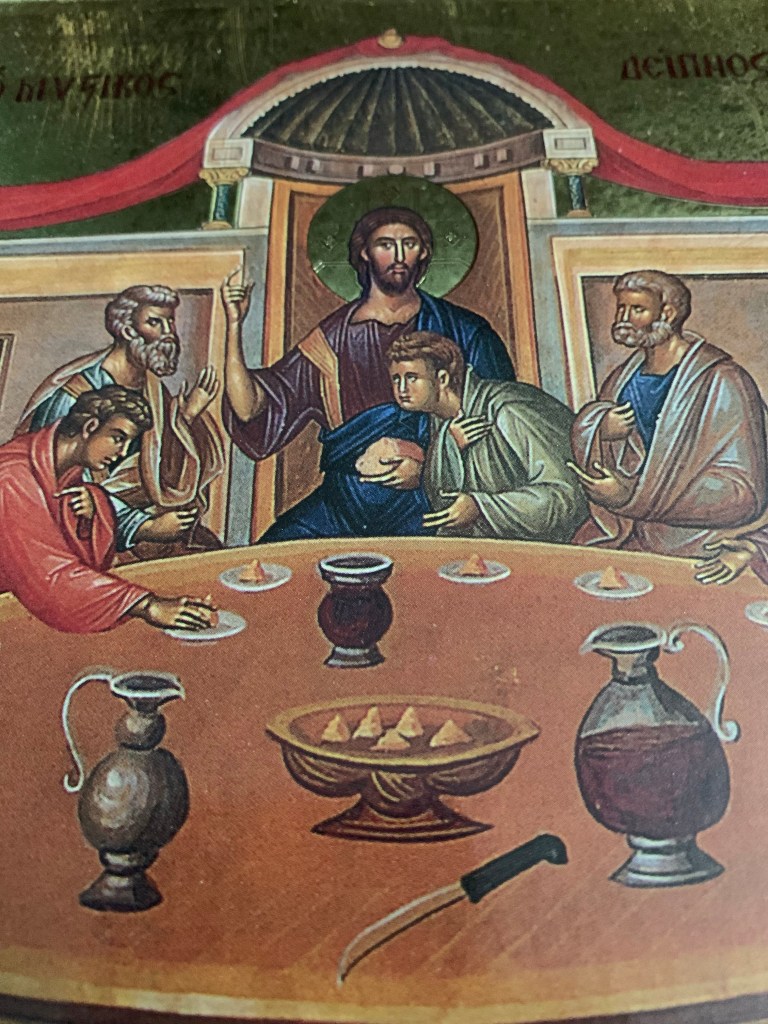
Today’s reading is from the Jerusalem Bible version of the Gospel of Luke, Chapter 22, verses 24 to 30:
“A dispute arose between the disciples about which should be reckoned the greatest, but Jesus said to them: ‘Among pagans it is the kings who lord it over them, and those who have authority over them are given the title Benefactor. This must not happen with you. No; the greatest among you must behave as if he were the youngest, the leader as if he were the one who serves. For who is the greater: the one at table or the one who serves? The one at table, surely? Yet here am I among you as one who serves! ‘You are the men who have stood by me faithfully in my trials; and now I confer a kingdom on you, just as my Father conferred one on me: you will eat and drink at my table in my kingdom, and you will sit on thrones to judge the twelve tribes of Israel.’” This is the Word of the Lord. Thanks be to God.
Even a quick reading of the Gospel would lead us to conclude that humility and selflessness are marks of the believer in Jesus Christ. For this reason, it seems surprising that even the Twelve Apostles would get mixed up in some silly debate as to who is the greatest. It seems even more surprising when we consider that the debate took place during the Last Supper, the night before Jesus would go to the cross for our sins!
This also was not the first time in which Jesus’ disciples had discussed who should be first. We should recall Mark 9:33-37, where a similar argument had taken place on the road while the disciples walked a distance away from Jesus. They thought that Jesus did not hear them, and yet Jesus took that moment to teach them all about the need for childlike humility. On another occasion in Mark 14:19, the mother of James and John had asked that her sons should sit to the right and to the left of Jesus in the Kingdom of Heaven. Yet, Jesus took that moment to teach them all that the greatest should become the servant and the one who wanted to be first should be the servant of everyone.
However, despite these repeated lessons, here the disciples were once again. They were still arguing over which of them was the greatest just as we approached our Lord and Savior’s death. Today’s passage shows us the humanity of the disciples. Each of us in our hearts know that it can be easy to understand the idea behind a lesson, but hard to put that lesson into practice within our own lives. It just might take someone to say or do the wrong thing in our opinion before we find ourselves thinking that we are the more faithful servant of Christ. Yet, the fundamental lesson of our faith remains true: the greatest before God are those who humbly serve. In being a servant, this means we must do more than come to church or to Sunday school on a regular basis. It is a way of thinking, a way of looking at the world as Christ would want us to do so. How do we begin to look at the world in that way?
First, we must look to the greatest example of servanthood: the life and ministry of Jesus Christ. As we will have read in John 13:1-11, Jesus got up during the Last Supper to wash the feet of his disciples. He faithfully served others when he alone deserves our worship and praise. He faithfully served others through the course of many trials and temptations during his life with us on Earth. He faithfully served others when, at times, Jesus might have been lonely or felt misunderstood. He faithfully served others because of his great love for us!
Second, we must look to the great enemy of servanthood: the work of the adversary within our own self. Seeking to serve might lead to a sense that we alone are special. This might lead to pride, which is followed close behind by selfishness. We even might feel a need to compete with others to show that we are more educated about our faith, or have particular experiences which give us greater insights into God’s nature or will. If we are not careful, we might follow the example of leadership from the world, sullying the sacred nature of Scripture itself as a blunt weapon in narrow, primitive cultural debates which favor one definition of self above another. Please be mindful at all times of how you think and how you behave to yourself and others. Guard your own heart against that which leads you away from Christ.
Third, we must look to the great encouragement of servanthood: the joy of God’s unmerited grace toward us despite our own brokenness. We can hear in today’s passage that Jesus was neither exasperated nor discouraged by the jockeying for position among his Apostles. Instead, he acknowledges them. He understands them. He reached out to commend them. He shows us that we, too, can come back from failure. He shows us that in our weakness, Christ’s strength is more than sufficient. In Him, we are enough. Through Him, our frail, finite selves can be used as examples to draw home all of the flock of our Good Shepherd. God’s grace gives us the faith and the resolve to go on.
Fourth, and last but not least, we must look to the ultimate enjoyment of servanthood: to have fellowship and service with our Lord and Savior even beyond the end of time. No one will be the mere Benefactor of his brother or of his sister. Instead, the Lord will reward all of His servants far beyond what we think they might deserve. His covenant with us will be kept. In giving, we receive. In losing success and accomplishment before the eyes of this world, we gain eternal life. By showing kindness and mercy, especially to those who cannot benefit us, or especially to those whom we might not understand or like, we can discern from the bright light beyond the thin veil that God is well pleased. All faithful servants will be welcomed, and the promise of the Kingdom of Heaven will always be an over-answer to our prayers. Amen and Amen.